Published by:
CGP EDU Academic Team
Published on: September 12, 2026
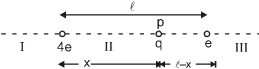
The distance between two fixed positive charges 4e and e is λ . How should a third charge ‘q’ be arranged for it to be in equilibrium? Under what condition will equilibrium of the charge ‘q’ be stable (for displacement on the line joining 4e and e) or will it be unstable?
Text Solution
Verified by ExpertsThe correct answer is:
C
Step 1: Let the two positive charges be placed at points A and B, where charge 4e is at point A (0, 0) and charge e is at point B (λ, 0). We want to place a third charge q at point P, located at a distance x from charge 4e along the line connecting charges 4e and e.
Step 2: The forces acting on charge q due to the other two charges are given by Coulomb's law. The force exerted by charge 4e on charge q is:
$$ F_{4e} = k \frac{4e |q|}{x^2} $$ (toward the left if q is on the left of charge 4e)
The force exerted by charge e on charge q is:
$$ F_e = k \frac{e |q|}{(\lambda - x)^2} $$ (toward the right if q is on the right of charge 4e)
Step 3: For the charge q to be in equilibrium, the net force on it must be zero. Therefore, we set up the equilibrium condition:
$$ F_{4e} = F_e $$
Substituting the force expressions, we have:
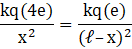
$$ k \frac{4e |q|}{x^2} = k \frac{e |q|}{(\lambda - x)^2} $$
Dividing both sides by k |q| (assuming q is not zero), we get:
$$ \frac{4e}{x^2} = \frac{e}{(\lambda - x)^2} $$
Simplifying, we find:
$$ 4(\lambda - x)^2 = x^2 $$
Step 4: Taking the square root of both sides gives us:
$$ 2(\lambda - x) = x $$
This simplifies to:
$$ 2\lambda - 2x = x $$
Therefore: $$ 3x = 2\lambda $$, leading to $$ x = \frac{2\lambda}{3} $$
This means charge q should be placed at a distance of \frac{2\lambda}{3} from charge 4e to achieve equilibrium.
Step 5: Next, we need to analyze the stability of this equilibrium position. For the equilibrium to be stable, a small displacement in either direction must result in a force that pushes the charge back towards the equilibrium position.
- If q is displaced slightly toward charge 4e, the force due to 4e must increase (which happens since the distance decreases) and the force due to e must decrease (since the distance increases) to push it back. Thus, it is stable if $\frac{F_{4e}}{F_e}$ decreases.
- Conversely, if q is displaced toward charge e, the force due to e must increase to push it back toward the original position. Thus, it is unstable if $\frac{F_{4e}}{F_e}$ increases.
Thus, equilibrium is stable when charge q is between the two charges and unstable if placed outside. Therefore, the correct answer is option C.
Step 2: The forces acting on charge q due to the other two charges are given by Coulomb's law. The force exerted by charge 4e on charge q is:
$$ F_{4e} = k \frac{4e |q|}{x^2} $$ (toward the left if q is on the left of charge 4e)
The force exerted by charge e on charge q is:
$$ F_e = k \frac{e |q|}{(\lambda - x)^2} $$ (toward the right if q is on the right of charge 4e)
Step 3: For the charge q to be in equilibrium, the net force on it must be zero. Therefore, we set up the equilibrium condition:
$$ F_{4e} = F_e $$
Substituting the force expressions, we have:
$$ k \frac{4e |q|}{x^2} = k \frac{e |q|}{(\lambda - x)^2} $$
Dividing both sides by k |q| (assuming q is not zero), we get:
$$ \frac{4e}{x^2} = \frac{e}{(\lambda - x)^2} $$
Simplifying, we find:
$$ 4(\lambda - x)^2 = x^2 $$
Step 4: Taking the square root of both sides gives us:
$$ 2(\lambda - x) = x $$
This simplifies to:
$$ 2\lambda - 2x = x $$
Therefore: $$ 3x = 2\lambda $$, leading to $$ x = \frac{2\lambda}{3} $$
This means charge q should be placed at a distance of \frac{2\lambda}{3} from charge 4e to achieve equilibrium.
Step 5: Next, we need to analyze the stability of this equilibrium position. For the equilibrium to be stable, a small displacement in either direction must result in a force that pushes the charge back towards the equilibrium position.
- If q is displaced slightly toward charge 4e, the force due to 4e must increase (which happens since the distance decreases) and the force due to e must decrease (since the distance increases) to push it back. Thus, it is stable if $\frac{F_{4e}}{F_e}$ decreases.
- Conversely, if q is displaced toward charge e, the force due to e must increase to push it back toward the original position. Thus, it is unstable if $\frac{F_{4e}}{F_e}$ increases.
Thus, equilibrium is stable when charge q is between the two charges and unstable if placed outside. Therefore, the correct answer is option C.
Prepare Smarter with CGP Edu
Get practice questions, solutions, and test series in one place.
Write a Review
Share your experience with this question and solution.
Commentary
Send your comment, doubt, correction, or feedback to admin.
Similar Questions
Explore conceptually related problems
Two point charges q 1 = 2 × 10 –3 C and q 2 = –3 × 10 –6 C are separated by a distance x = 10 cm. F…
Two point charges q 1 = 20 µC and q 2 = 25 µC are placed at (–1, 1, 1) m and (3, 1, –2)m, with resp…
20 positively charged particles are kept fixed on the X-axis at points x = 1 m, 2 m, 3 m, ....., 20…
(i) Two charged particles having charge 4.0 × 10 –6 C and mass 24 × 10 –3 Kg each are joined by an …
Two identical conducting spheres (of negligible radius), having charges of opposite sign, attract e…
Two small spheres, each of mass 0.1 gm and carrying same charge 10 -9 C are suspended by threads of…